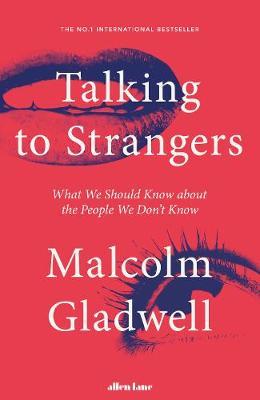
Malcolm Gladwell writes books that feel like revelations for about a week, then you’re not sure what you actually learned. I also find his style a bit random and not easy to follow.
I really want to like his books though, because he has such great ideas.
So this time round I read “Talking to Strangers”. Actually, I listened to it. It’s actually ok, in spite of Gladwell’s rambling, and the audio version has great music too.
Also, a few ideas actually stuck. Let me tell you about them.
The premise
The book starts from American police brutality towards blacks to ask a simple question: why are we so bad at understanding strangers?
Gladwell builds his answer through a series of cherry-picked case studies going from Cuban spies who operated undetected for decades to the wrongful conviction of Amanda Knox. From Bernie Madoff’s fraud to the police encounter that killed Sandra Bland. He claims each case is a failure of strangers to understand each other correctly. And each case, Gladwell argues, isn’t an anomaly. It’s the system working as designed.
The storytelling wanders. He can’t help himself. But the core thesis holds together, though you need to put things under a more conceptual than practical or scientific perspective. And, to be fair, this has been the biggest critique to this work, online.
Default to truth
This is the sharpest idea in the book.
We assume people are telling the truth. Not just sometimes, but almost always, as a default setting. And we believe that subconsciously.
This sounds like a flaw. It’s not. It’s a feature.
Society runs on the assumption that most people aren’t lying most of the time. Think about how many interactions you have in a day where you simply take what someone says at face value. Your colleague tells you the meeting moved. The barista says they’re out of oat milk. Your partner says they’ll be home late. You don’t verify any of it. You just believe them.
The alternative is paranoia. Constantly doubting everyone would make normal life impossible. So we default to trust, and occasionally we get burned. That’s the trade-off. It’s not a flaw to fix. It’s a cost to accept.
Ana Montes worked at the Defense Intelligence Agency for 17 years while spying for Cuba. Aldrich Ames passed secrets to the Soviets for nearly a decade while employed by the CIA. These weren’t amateurs hiding in plain sight. They were surrounded by trained intelligence professionals whose literal job was to spot deception.
And they missed it. Not because they were incompetent, but because defaulting to truth is that deeply wired.
The uncomfortable corollary: the people who do catch liars early are often the ones who can’t function normally. The colleague who suspected Ana Montes was dismissed as paranoid, difficult, not a team player. She was right. But being good at spotting deception might mean being bad at earning trust.
The transparency illusion
We believe faces reveal feelings.
Someone looks nervous, we assume they’re hiding something. Someone looks calm, we assume they’re telling the truth. Someone doesn’t cry at a funeral, we wonder what’s wrong with them.
This assumption is built on a lie. Or rather, it’s built on movies.
Actors are selected specifically because their emotions read clearly on their faces. That’s the job. Over decades, we’ve trained ourselves to expect that level of transparency from everyone, but real people don’t work that way.
Amanda Knox went to prison, according to Gladwell, largely because she didn’t perform grief correctly. After her roommate was murdered, Knox behaved in ways that struck investigators as “off.” She didn’t cry enough. She did cartwheels in the police station. She kissed her boyfriend. Professionals watched her and concluded she must be guilty, because her behaviour didn’t match what they expected from an innocent person.
Knox is what Gladwell calls a “mismatched” person: someone whose face and feelings don’t align in the ways we expect. The problem is, there are more mismatched people than we think. And we have no reliable way to know who they are.
The next time you’re certain you’ve read someone correctly, remember: your certainty is based on a mental model trained by sitcoms.
Coupling
Behaviour is tied to context more than we want to admit.
We love personality explanations. “He’s just that kind of guy.” “She’s always been difficult.” “That’s who he is.” It feels like insight. It’s usually lazy.
Take for example is suicide. When Britain switched from coal gas to natural gas in the 1960s, suicide rates dropped dramatically - and stayed down. The expectation was that people would just find other methods. They didn’t. The impulse was coupled to the opportunity. Remove the specific means, and the behavior didn’t transfer.
This isn’t unique to suicide. Crime is coupled to place. A handful of street corners generate most of a city’s violence. Policing those specific locations works. Applying the same aggressive tactics everywhere doesn’t.
Coupling is a useful corrective. When someone behaves badly, ask what the situation is producing before deciding what the person is. When you behave badly, extend yourself the same courtesy.
What stays with me
I generally think of myself as someone who’s good at reading people. I’ve been in rooms where I was sure I had someone figured out, interviews where the candidate just “felt right” or “felt off”, conversations where I decided instinctively if someone was trustworthy or not.
This isn’t wrong, it’s human. The problem isn’t that we try to read strangers (we can’t quite avoid it). The problem is that we’re too confident about it.
The default to truth is useful until it isn’t. The transparency illusion is harmless until it gets someone completely wrong. Coupling explains but we forget and blame the person instead.
The solution isn’t to become paranoid. It’s to hold conclusions loosely: remember that the stranger in front of you is operating with their own context, their own history, their own mismatches, and that you have access to almost none of it.
Should you read it?
There’s been some strong and kind of reasonable critique of this work. Gladwell is a writer, not a scientist or a psychologist, or a sociologist. So he doesn’t know shit about how to present studies. He cherrypicks, amplifies, deviates, seems to justify in somewhat forced ways pretty hardcore things like child rape or police brutality (spoilers: he doesn’t, he’s just shit at analysis).
So, should you read it? I think yes, especially if you make decisions about people based on interactions. Hiring, managing, evaluating. Just know that this book won’t give you a framework for doing it better or an analysis of the issues. It’s more of a rambling picnic of really interesing (to me) food for thought.
But yeah, if you’re allergic to Gladwell’s style (meandering, over-explaining, rambling, a little entitled), skip it. I think this is the sharpest Gladwell I tried to read, but it’s still very much him.
4 out of 5. Worth the time, but needs some work.